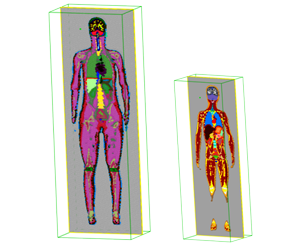
Simulation of thermal effects of Wi-Fi electromagnetic fields on humans using FDTDLab
DOI:
https://doi.org/10.3103/S0735272724110013Keywords:
EMF, FDTD, SAR, human-based model, temperature riseAbstract
Currently, humans are living in an environment of increasing electromagnetic (EM) pollution. It is related to developing and introducing current-technology communication equipment, such as phones, computers, Wi-Fi, and cellular networks. It results in a natural EM background violation. Continuous exposure to a high-intensity electromagnetic field (EMF) can be hazardous to both human health and the health of entire living organisms. Consequently, the EMF effect remains a highly relevant problem, prompting continued research efforts.
The purpose of the presented research is to study the thermal effects of electromagnetic field (EMF) exposure on humans at the 2.4 GHz Wi-Fi frequency using numerical simulations. We performed the numerical calculations using FDTDLab, a simulation software based on the finite-difference time-domain (FDTD) method. The FDTD method provides a powerful means to simulate the effects of radiation from wireless communication devices on biological tissues. Using the simulation results, we estimate EMF absorption by human bodies (female and child) in terms of specific absorption rate (SAR) and induced dielectric heating. We calculated the 1g and 10g mass-averaged Specific Absorption Rate (SAR), the whole-body-averaged SAR, and the temperature rise within the human body and its parts. These results were then assessed against international safety limits for SAR and temperature rise to confirm compliance.
References
- IEEE, “IEEE standard for safety levels with respect to human exposure to radio frequency electromagnetic fields, 3 kHz to 300 GHz.” IEEE, Piscataway, NJ, USA, 03-Oct-2005, doi: https://doi.org/10.1109/IEEESTD.2006.99501.
- IEEE, “IEEE C95.1-2019, IEEE standard for safety levels with respect to human exposure to electric, magnetic, and electromagnetic fields, 0 Hz to 300 GHz,” 2019.
- “Guidelines for limiting exposure to time-varying electric, magnetic, and electromagnetic fields (up to 300 GHz). International Commission on Non-Ionizing Radiation Protection.,” Health Phys., vol. 74, no. 4, pp. 494–522, 1998, uri: http://www.ncbi.nlm.nih.gov/pubmed/9525427.
- “Guidelines for limiting exposure to electromagnetic fields (100 kHz to 300 GHz),” Health Phys., vol. 118, no. 5, pp. 483–524, 2020, doi: https://doi.org/10.1097/HP.0000000000001210.
- M. Abdul-Al et al., “Wireless electromagnetic radiation assessment based on the specific absorption rate (SAR): a review case study,” Electronics, vol. 11, no. 4, p. 511, 2022, doi: https://doi.org/10.3390/electronics11040511.
- A. Turgut, B. K. Engiz, “Analyzing the SAR in human head tissues under different exposure scenarios,” Appl. Sci., vol. 13, no. 12, p. 6971, 2023, doi: https://doi.org/10.3390/app13126971.
- T. Nozadze, V. Jeladze, R. Zaridze, “Mobile antenna matching study considering different holding positions at 2100 MHz frequency,” in 2020 IEEE XXVth International Seminar/Workshop Direct and Inverse Problems of Electromagnetic and Acoustic Wave Theory (DIPED), 2020, pp. 121–125, doi:
- https://doi.org/10.1109/DIPED49797.2020.9273363.
- T. Nozadze, V. Jeladze, M. Tsverava, V. Tabatadze, M. Prishvin, R. Zaridze, “EM exposure study on an inhomogeneous child model considering hand effect,” in 2017 IEEE First Ukraine Conference on Electrical and Computer Engineering (UKRCON), 2017, pp. 51–54, doi: https://doi.org/10.1109/UKRCON.2017.8100484.
- V. Jeladze, T. Nozadze, I. Petoev-Darsavelidze, B. Partsvania, “Mobile phone antenna-matching study with different finger positions on an inhomogeneous human model,” Electromagn. Biol. Med., vol. 38, no. 4, pp. 297–306, 2019, doi: https://doi.org/10.1080/15368378.2019.1641721.
- T. Nozadze, K. Henke, M. Kurtsikidze, V. Jeladze, G. Ghvedashvili, R. Zaridze, “Study how the hand affects on the mobile phone dipole antenna matching conditions to the free space at 3700 MHz frequency,” in 2022 IEEE 2nd Ukrainian Microwave Week (UkrMW), 2022, pp. 439–443, doi: https://doi.org/10.1109/UkrMW58013.2022.10037056.
- M. Wyde et al., “Report of partial findings from the National Toxicology Program Carcinogenesis studies of cell phone radiofrequency radiation in Hsd: sprague Dawley ® SD rats (Whole Body Exposures).” 26-May-2016, doi: https://doi.org/10.1101/055699.
- J. Mydlová, I. Gálová, M. Beňová, “Impact of electromagnetic fields in transport on active implantable medical devices,” Transp. Res. Procedia, vol. 40, pp. 1497–1503, 2019, doi: https://doi.org/10.1016/j.trpro.2019.07.207.
- G. Redlarski et al., “The influence of electromagnetic pollution on living organisms: historical trends and forecasting changes,” BioMed Res. Int., vol. 2015, pp. 1–18, 2015, doi: https://doi.org/10.1155/2015/234098.
- Z. Szilágyi et al., “Assessment of inflammation in 3D reconstructed human skin exposed to combined exposure to ultraviolet and Wi-Fi radiation,” Int. J. Mol. Sci., vol. 24, no. 3, p. 2853, 2023, doi: https://doi.org/10.3390/ijms24032853.
- R. Sánchez-Montero, C. Alén-Cordero, P. L. López-Espí, J. M. Rigelsford, F. Aguilera-Benavente, J. Alpuente-Hermosilla, “Long term variations measurement of electromagnetic field exposures in Alcalá de Henares (Spain),” Sci. Total Environ., vol. 598, pp. 657–668, 2017, doi: https://doi.org/10.1016/j.scitotenv.2017.03.131.
- T. Mazloum, S. Aerts, W. Joseph, J. Wiart, “RF-EMF exposure induced by mobile phones operating in LTE small cells in two different urban cities,” Ann. Telecommun., vol. 74, no. 1–2, pp. 35–42, 2019, doi: https://doi.org/10.1007/s12243-018-0680-1.
- R. N. Iyare, V. Volskiy, G. A. E. Vandenbosch, “Study of the correlation between outdoor and indoor electromagnetic exposure near cellular base stations in Leuven, Belgium,” Environ. Res., vol. 168, pp. 428–438, 2019, doi: https://doi.org/10.1016/j.envres.2018.08.025.
- J. Liu, M. Wei, H. Li, X. Wang, X. Wang, S. Shi, “Measurement and mapping of the electromagnetic radiation in the urban environment,” Electromagn. Biol. Med., vol. 39, no. 1, pp. 38–43, 2020, doi: https://doi.org/10.1080/15368378.2019.1685540.
- C. Kurnaz, M. Mutlu, “Comprehensive radiofrequency electromagnetic field measurements and assessments: a city center example,” Environ. Monit. Assess., vol. 192, no. 6, p. 334, 2020, doi: https://doi.org/10.1007/s10661-020-08312-3.
- Ç. Kurnaz, B. Korunur Engiz, “Measurement and evaluation of electric field strength in Samsun city center,” Int. J. Appl. Math. Electron. Comput., vol. 4, no. Special Issue-1, pp. 24–24, 2016, doi: https://doi.org/10.18100/ijamec.271016.
- J. Keshvari, T. Heikkilä, “Volume-averaged SAR in adult and child head models when using mobile phones: A computational study with detailed CAD-based models of commercial mobile phones,” Prog. Biophys. Mol. Biol., vol. 107, no. 3, pp. 439–442, 2011, doi: https://doi.org/10.1016/j.pbiomolbio.2011.10.001.
- E. Conil, A. Hadjem, F. Lacroux, M. F. Wong, J. Wiart, “Variability analysis of SAR from 20 MHz to 2.4 GHz for different adult and child models using finite-difference time-domain,” Phys. Med. Biol., vol. 53, no. 6, pp. 1511–1525, 2008, doi: https://doi.org/10.1088/0031-9155/53/6/001.
- Z. Psenakova, M. Benova, T. Laukova, “Investigation of specific absorption rate (SAR) near model of fetus in uterus,” in 2020 ELEKTRO, 2020, pp. 1–6, doi: https://doi.org/10.1109/ELEKTRO49696.2020.9130308.
- ITU, “ITU EMF Guide,” 2011. uri: http://emfguide.itu.int/pdfs/pr208_E.pdf.
- A. Taflove, Computational Electrodynamics: The Finite-Difference Time-Domain Method. Artech House, 1995.
- H. H. Pennes, “Analysis of tissue and arterial blood temperatures in the resting human forearm,” J. Appl. Physiol., vol. 1, no. 2, pp. 93–122, 1948, doi: https://doi.org/10.1152/jappl.1948.1.2.93.
- K. Yee, “Numerical solution of initial boundary value problems involving maxwell’s equations in isotropic media,” IEEE Trans. Antennas Propag., vol. 14, no. 3, pp. 302–307, 1966, doi: https://doi.org/10.1109/TAP.1966.1138693.
- P. A. Hasgall et al., “IT’IS Database for thermal and electromagnetic parameters of biological tissues,” Web-site, 2025. http://itis.swiss/database.
- “Human models,” Web-site. https://itis.swiss/virtual-population/virtual-population/overview/.
- FCC, “Radio Frequency Safety,” Web-site, 2019. https://www.fcc.gov/general/radio-frequency-safety-0#:~:text=The SAR is a value,(1.6 W%2Fkg).
- T. Nozadze, J. Haueisen, V. Jeladze, “Assessment of electromagnetic field exposure to humans at 2.4 GHz Wi-Fi frequency,” in 2024 IEEE 29th International Seminar/Workshop on Direct and Inverse Problems of Electromagnetic and Acoustic Wave Theory (DIPED), 2024, pp. 180–185, doi: https://doi.org/10.1109/DIPED63529.2024.10706179.
- L. Hardell, “Effects of mobile phones on children’s and adolescents’ health: a commentary,” Child Dev., vol. 89, no. 1, pp. 137–140, 2018, doi: https://doi.org/10.1111/cdev.12831.
- J. F. Bakker, M. M. Paulides, A. Christ, N. Kuster, G. C. van Rhoon, “Assessment of induced SAR in children exposed to electromagnetic plane waves between 10 MHz and 5.6 GHz,” Phys. Med. Biol., vol. 55, no. 11, pp. 3115–3130, 2010, doi: https://doi.org/10.1088/0031-9155/55/11/009.
- “List of Classifications,” Agents classified by the IARC Monographs. https://monographs.iarc.who.int/list-of-classifications.
- D. Leszczynski, “Call for consensus debate on mobile phone radiation and health: Are current safety guidelines sufficient to protect everyone’s health?,” Front. Public Heal., vol. 10, 2022, doi: https://doi.org/10.3389/fpubh.2022.1085821.