Search method for identifying permutation sequence groups of maximum size with specified cross-correlation level for IC-FSCM modulation
DOI:
https://doi.org/10.3103/S073527272409005XKeywords:
spectrum spreading, interference-proof communication, bit error probability, spectral efficiency, CSS, LoRa, FSCM, IC-FSCMAbstract
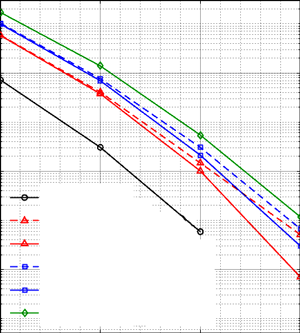
The paper considers methods for modulating signals with a spread spectrum based on signals with linear frequency modulation CSS (Chirp Spread Spectrum). One of the methods of data coding based on CSS signals is the cyclic frequency shift of the LFM pulse known as Frequency Shift Chirp Modulation (FSCM). The Interleaved Chirp FSCM (IC-FSCM) modulation method uses a set of permutation sequences of the LFM pulse segments to encode additional information bits. It has a higher spectral efficiency compared to the FSCM method. The minimum level of cross-correlation between the signals obtained by using different permutation sequences is essential. We propose a search method for identifying groups of permutation sequences with a specified maximum level of cross-correlation, which involves representing the matrix of cross-correlation between sequences as a graph and searching for complete subgraphs of maximum size within this graph using the Bron-Kerbosch algorithm. As a result of applying the algorithm, groups of sequences have been identified that enable us to increase the number of additional bits in a symbol to 5 without increasing the level of cross-correlation between symbols. Additionally, we have reduced the level of cross-correlation between symbols when the number of additional bits is set to 3 and 4. The characteristics of the found sequences and the distribution of error probability among the main and additional bits of the symbol have been analyzed.
References
- D. S. Dayton, “FM ‘chirp’ communications: multiple access to dispersive channels,” IEEE Trans. Electromagn. Compat., vol. EMC-10, no. 2, pp. 296–297, 1968, doi: https://doi.org/10.1109/TEMC.1968.302967.
- A. Springer, W. Gugler, M. Huemer, R. Koller, R. Weigel, “A wireless spread-spectrum communication system using SAW chirped delay lines,” IEEE Trans. Microw. Theory Tech., vol. 49, no. 4, pp. 754–760, 2001, doi: https://doi.org/10.1109/22.915460.
- P. Zhang, H. Liu, “An ultra-wide band system with chirp spread spectrum transmission technique,” in 2006 6th International Conference on ITS Telecommunications, 2006, pp. 294–297, doi: https://doi.org/10.1109/ITST.2006.288877.
- L. Vangelista, “Frequency shift chirp modulation: the LoRa modulation,” IEEE Signal Process. Lett., vol. 24, no. 12, pp. 1818–1821, 2017, doi: https://doi.org/10.1109/LSP.2017.2762960.
- R. Bomfin, M. Chafii, G. Fettweis, “A novel modulation for IoT: PSK-LoRa,” in 2019 IEEE 89th Vehicular Technology Conference (VTC2019-Spring), 2019, pp. 1–5, doi: https://doi.org/10.1109/VTCSpring.2019.8746470.
- M. Hanif, H. H. Nguyen, “Slope-shift keying LoRa-based modulation,” IEEE Internet Things J., vol. 8, no. 1, pp. 211–221, 2021, doi: https://doi.org/10.1109/JIOT.2020.3004318.
- T. Elshabrawy, J. Robert, “Interleaved chirp spreading LoRa-based modulation,” IEEE Internet Things J., vol. 6, no. 2, pp. 3855–3863, 2019, doi: https://doi.org/10.1109/JIOT.2019.2892294.
- Y. Shi, W. Xu, L. Wang, “An enhanced interleaved chirp spreading LoRa modulation scheme for high data transmission,” in 2022 Wireless Telecommunications Symposium (WTS), 2022, pp. 1–6, doi: https://doi.org/10.1109/WTS53620.2022.9768322.
- P. Edward, E. Tarek, M. El-Aasser, M. Ashour, T. Elshabrawy, “Further LoRa capacity enhancement through interleaved chirp spreading LoRa expansion,” in 2019 International Conference on Wireless and Mobile Computing, Networking and Communications (WiMob), 2019, pp. 1–6, doi: https://doi.org/10.1109/WiMOB.2019.8923337.
- M. I. Mazurkov, Broadband radio systems, [in Russian]. Odessa: Nauka і Technika, 2010.
- M. I. Mazurkov, V. S. Dmitrenko, “A regular rule for generation of full classes of optimal systems of DF-signals based on the method of decimation,” Radioelectron. Commun. Syst., vol. 48, no. 2, pp. 34–36, 2005, doi: https://doi.org/10.3103/S0735272705020068.
- M. I. Mazurkov, V. S. Dmitrenko, “The class of optimal systems of DF-signals based on M-sequences in the extended Galois fields,” Radioelectron. Commun. Syst., vol. 47, no. 12, pp. 11–13, 2004, doi: https://doi.org/10.3103/S0735272704120039.
- C. Bron, J. Kerbosch, “Algorithm 457: finding all cliques of an undirected graph,” Commun. ACM, vol. 16, no. 9, pp. 575–577, 1973, doi: https://doi.org/10.1145/362342.362367.
- F. Cazals, C. Karande, “A note on the problem of reporting maximal cliques,” Theor. Comput. Sci., vol. 407, no. 1–3, pp. 564–568, 2008, doi: https://doi.org/10.1016/j.tcs.2008.05.010.